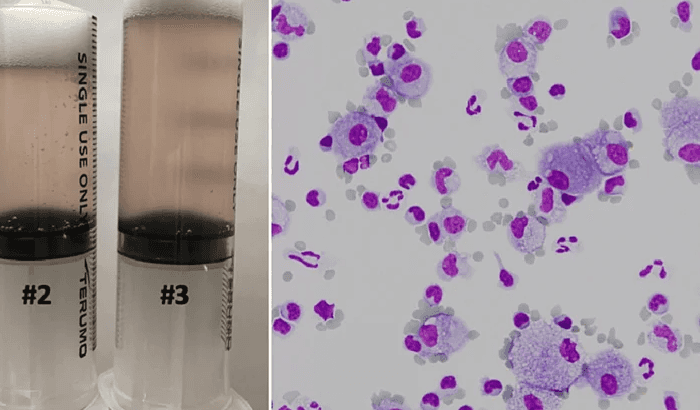
why bal
An irreplaceable window into the distal airway
BAL reaches the alveolar compartment directly, and remains the reference sample for interstitial lung disease, alveolitis, transplant surveillance and severe airway inflammation.
It is also one of the most expensive and least repeatable samples in respiratory research. Every vial represents a bronchoscopy, a sedated patient and a procedural risk.
You get one attempt at the analysis.
That changes the question from "what can we measure?" to "how much biology can we preserve from a sample we may never obtain again?"
the challenge
The problem is not volume. It is dilution.
Lavage returns millilitres, so volume is rarely the constraint. What matters is what those millilitres contain.
Heavy dilution
Saline instilled into the airway mixes with a thin layer of epithelial lining fluid and returns overwhelmingly as saline. The biology of interest can be diluted by one or two orders of magnitude before the sample reaches a tube.
Variable dilution
The dilution factor is not fixed. It shifts with instilled volume, dwell time, suction pressure, lobe sampled, wedge position and operator, and returned volume varies substantially between procedures and between patients.
Two samples collected under the same protocol are not necessarily comparable. The difference may be procedural rather than biological.
Imperfect correction
Urea dilution, albumin and total protein are all used as correction approaches. Each carries assumptions debated in the literature, and none fully solves the problem.
Correction also fails when the analyte is already at the edge of detection. Dilution correction cannot rescue a marker the assay never detected. Sensitivity has to come first.
the challenge
Sensitivity before correction
Heavy dilution is only part of the challenge. BAL also carries cellular material, mucus and protease activity, which together make conventional immunoassays prone to non-detects for the low-abundance mediators that distinguish one disease phenotype from another.
The conventional compromise
1. DNA-barcoded antibodies
Paired antibodies carry DNA barcodes.
2. Sequential capture and wash
Unbound reagent and matrix components are removed before readout, so the interference is gone before the assay reads anything.
3. Ultra-sensitive readout
Barcode sequencing delivers attomolar sensitivity across up to 340 targets from microlitre inputs.
The result
One irreplaceable sample yields a full panel, and leaves material for orthogonal work.


what to use
What you would measure
BAL work centres on immune profiling of the alveolar compartment: cytokines, chemokines and soluble mediators from a single sample. Which panel fits depends on the question, and we will work through it with you.
Choose breadth or absolute quantification
We are one of only five laboratories worldwide certified for NULISA custom assay development, and the UK's first Alamar Certified Service Provider for NULISA.
NULISA
For broad, ultra-sensitive profiling where extracting the most biology from a limited BAL sample is the priority.
Up to 340 targets from microlitre inputs, reported in NPQ units as relative quantification.
Simoa and MSD
Where the study needs absolute quantification in pg/mL across a defined marker set.
Relevant where BAL results must be compared against published data, external cohorts or a regulated dataset.
Make more of every BAL sample
Archived collections
Many respiratory research groups hold banked BAL that was originally assayed for a handful of markers and has sat at −80°C ever since.
Those collections can be worth more than anything a new study could recruit:
Clinical follow-up is already mature
Some cohorts can no longer be assembled
Recollection may be impossible or inappropriate
The samples already exist
Revisit the archive without consuming it
A 340-target panel from microlitre inputs makes retrospective interrogation practical without exhausting the archive. Tell us the storage and freeze and thaw history of the collection, however untidy it is, and we will give you our view on what is recoverable from it before any of it is committed.
Sample requirements
Volume to ship: set by the assay, not by the matrix. Ship what your assay requires plus roughly 10 µL of dead volume, so there is material for a repeat. BAL is a specialist matrix, so we confirm the usable volume after centrifugation at scoping
Processing: centrifuged, supernatant only. Cellular fraction handled at the collection site
Aliquoting: single-use aliquots, to avoid repeat freeze and thaw
Freeze and thaw: as few cycles as possible, and within the limit for the platform you will run: up to three to five cycles on NULISA depending on panel, three to four on Simoa, two on MSD. Tell us the freeze and thaw history of archived material, however untidy it is
Storage: −80°C
Shipping: on dry ice, with a manifest listing sample ID, volume, collection date and freeze and thaw history
Protease inhibition: BAL carries protease activity, so consider inhibition at collection. If your protocol is already fixed and validated, we will work to it
These are recommendations, not conditions. If your collection protocol differs, tell us what it is and we will design around it.
We confirm receipt and condition in writing on the day samples arrive, before anything is consumed.
Shipping samples internationally
We can arrange collection and shipping, or work with your courier. Logistics, temperature control and documentation are confirmed at scoping, before any samples move.

Quality for an invasive, consented sample
For research use only. Not for use in diagnostic procedures.
Discuss your matrix with a scientist
Tell us your return volumes, your correction reference, the markers that matter and whether the collection is fresh or archived.
You will get a straight view on feasibility, platform and timing before you commit a single vial.