Longitudinal Inflammatory Biomarker Profiling with Ultra-Sensitive Proteomics
Longitudinal Inflammatory Biomarker Profiling with Ultra-Sensitive Proteomics
Longitudinal Inflammatory Biomarker Profiling with Ultra-Sensitive Proteomics
Introduction
Ageing is driven by dynamic, interconnected processes, chronic inflammation, immune changes, and tissue remodelling, that vary over time and with lifestyle or environment. Inflammation is a central driver of ageing and age-related disease, yet its biology is highly dynamic and difficult to capture using conventional biomarker technologies.
Traditional biomarker approaches often miss early signals, capture only a narrow slice of biology, and rely on single-timepoint measurements.
Altheome’s NULISA platform has several advantages when compared to other methods such as:
Early detection of biological changes before clinical signs appear
Mechanistic insight into inflammaging and immune dysregulation
Personalised tracking of lifestyle interventions or treatments
Biomarker stratification for translational and precision health studies
This allows for a high-sensitivity, system-level insight into the biology of ageing.
Introduction
Ageing is driven by dynamic, interconnected processes, chronic inflammation, immune changes, and tissue remodelling, that vary over time and with lifestyle or environment. Inflammation is a central driver of ageing and age-related disease, yet its biology is highly dynamic and difficult to capture using conventional biomarker technologies.
Traditional biomarker approaches often miss early signals, capture only a narrow slice of biology, and rely on single-timepoint measurements.
Altheome’s NULISA platform has several advantages when compared to other methods such as:
Early detection of biological changes before clinical signs appear
Mechanistic insight into inflammaging and immune dysregulation
Personalised tracking of lifestyle interventions or treatments
Biomarker stratification for translational and precision health studies
This allows for a high-sensitivity, system-level insight into the biology of ageing.
Experimental Design
Longitudinal case study (n = 1) with 17 sampling time points over 15 months
Blinded sample processing
Within-individual analysis to maximise biological resolution
This study was designed to demonstrate how longitudinal, ultra-sensitive biomarker profiling can reveal dynamic inflammatory biology and capture biologically meaningful responses to real-world events.
Experimental Design
Longitudinal case study (n = 1) with 17 sampling time points over 15 months
Blinded sample processing
Within-individual analysis to maximise biological resolution
This study was designed to demonstrate how longitudinal, ultra-sensitive biomarker profiling can reveal dynamic inflammatory biology and capture biologically meaningful responses to real-world events.
Technology Spotlight: The NULISA™ Platform Ultra-Sensitive Multiplex Proteomics at Scale
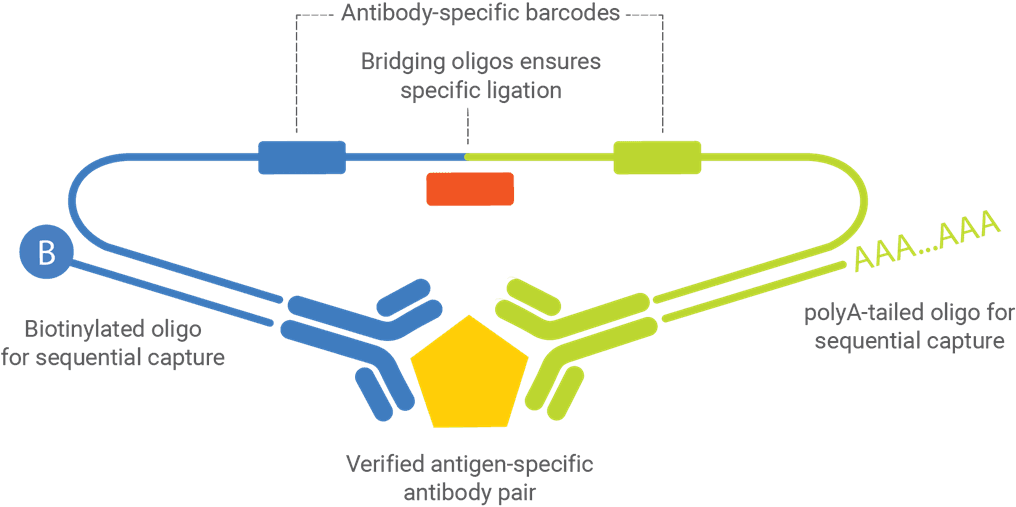
Inflammatory biomarkers were measured using Altheome’s NULISA™ platform, an antibody-based multiplex technology with next-generation sequencing (NGS) readout.
Key capabilities demonstrated in this study:
Simultaneous measurement of ~250 inflammatory and immune-related proteins
Paired-antibody detection strategy to minimise background signal
Attomolar-level sensitivity, enabling detection of extremely low-abundance biomarkers
Digital NGS readout providing high dynamic range and quantitative precision
These capabilities allow NULISA to detect early biological changes that are often invisible to conventional immunoassays.
Technology Spotlight: The NULISA™ Platform Ultra-Sensitive Multiplex Proteomics at Scale
Inflammatory biomarkers were measured using Altheome’s NULISA™ platform, an antibody-based multiplex technology with next-generation sequencing (NGS) readout.
Key capabilities demonstrated in this study:
Simultaneous measurement of ~250 inflammatory and immune-related proteins
Paired-antibody detection strategy to minimise background signal
Attomolar-level sensitivity, enabling detection of extremely low-abundance biomarkers
Digital NGS readout providing high dynamic range and quantitative precision
These capabilities allow NULISA to detect early biological changes that are often invisible to conventional immunoassays.
Data Analysis - Network-Based Biomarker Clustering
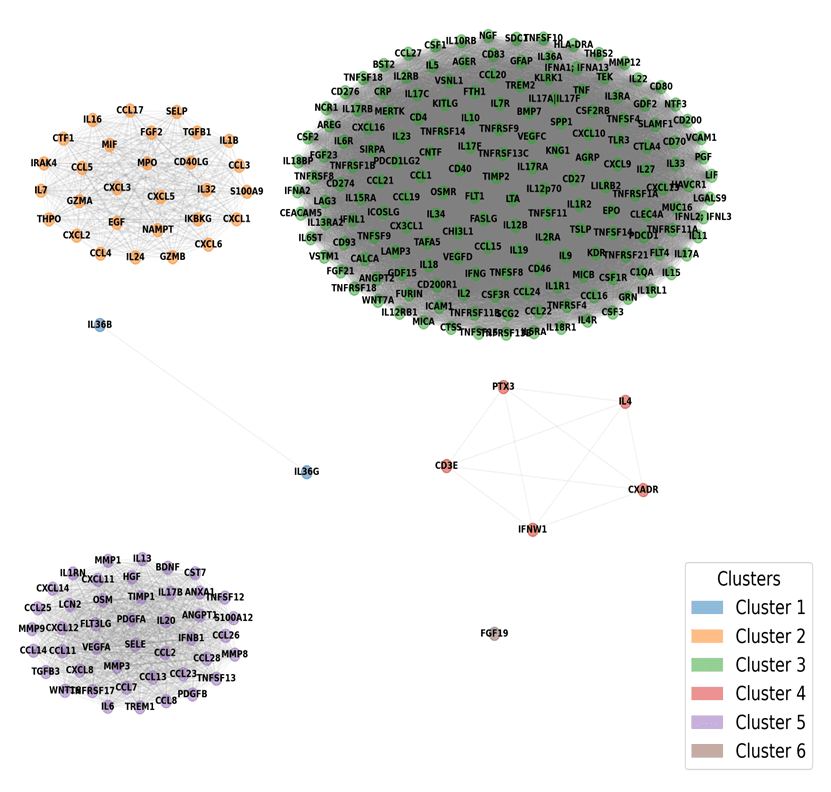
To fully leverage the depth of the NULISA dataset, biomarkers were analysed using a network-based approach, identifying co-regulated protein clusters rather than relying on single-analyte readouts.
Data Analysis - Network-Based Biomarker Clustering
To fully leverage the depth of the NULISA dataset, biomarkers were analysed using a network-based approach, identifying co-regulated protein clusters rather than relying on single-analyte readouts.
Six biologically distinct inflammatory clusters were identified:
Cluster 1 = Skin inflammation / Chemokine signalling
Cluster 2 = Autoimmune inflammation / IL-17 signalling
Cluster 3 = Inflammatory injury response
Cluster 4 = Type-2 Immune activation
Cluster 5 = Wound healing / angiogenesis
Cluster 6 = Metabolic & hormonal regulation
Key Findings: Capturing Real-World Biology
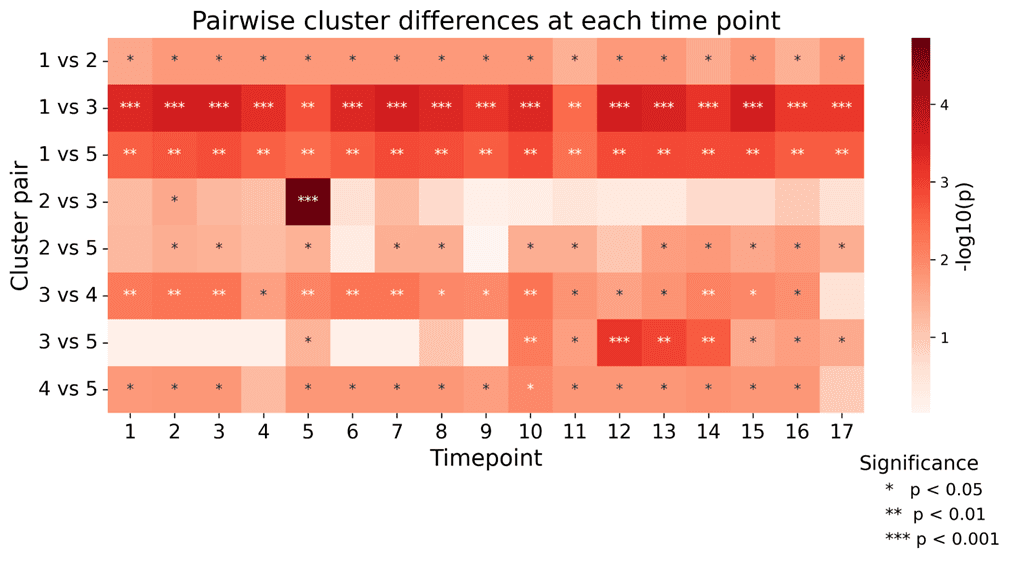
Longitudinal comparison of biomarker clusters revealed coordinated inflammatory shifts that aligned with significant life events.
Key Findings: Capturing Real-World Biology
Longitudinal comparison of biomarker clusters revealed coordinated inflammatory shifts that aligned with significant life events.
Notable patterns included:
Autoimmune and allergic inflammation signatures (2 vs 3) coinciding with injury-related inflammatory responses
Tissue remodelling, angiogenesis, and neuroprotective signals (3 vs 5) emerging during recovery phases
Notable patterns included:
Autoimmune and allergic inflammation signatures (2 vs 3) coinciding with injury-related inflammatory responses
Tissue remodelling, angiogenesis, and neuroprotective signals (3 vs 5) emerging during recovery phases
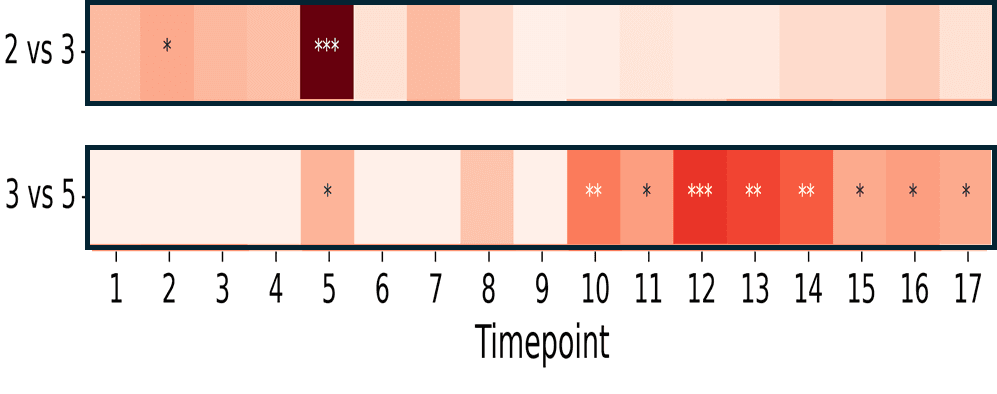
These findings illustrate how NULISA enables detection of biologically coherent responses across interconnected pathways, rather than isolated biomarker fluctuations.
Conclusion
This work showcases how Altheome’s NULISA™ platform enables ultra-sensitive, longitudinal biomarker profiling that bridges discovery and translation. By capturing dynamic immune networks over time, NULISA supports early detection, mechanistic insight, and personalised monitoring - key pillars of longevity and precision health research.
Conclusion
This work showcases how Altheome’s NULISA™ platform enables ultra-sensitive, longitudinal biomarker profiling that bridges discovery and translation. By capturing dynamic immune networks over time, NULISA supports early detection, mechanistic insight, and personalised monitoring - key pillars of longevity and precision health research.