Proteomic Profiling of Systemic Response to Exercise
Proteomic Profiling of Systemic Response to Exercise
Proteomic Profiling of Systemic Response to Exercise
Introduction
Understanding how lifestyle factors, such as acute exercise, influence circulating proteins and impact disease-relevant cells can reveal critical insights into human health and disease. Detecting these systemic changes requires highly sensitive and multiplexed proteomic technologies. Traditional immunoassays often fall short in measuring low-abundance proteins in complex biological fluids, such as serum or plasma. These proteins, while present at very low concentrations, frequently mediate key biological processes, including immune signalling, DNA repair, and metabolism.
Introduction
Understanding how lifestyle factors, such as acute exercise, influence circulating proteins and impact disease-relevant cells can reveal critical insights into human health and disease. Detecting these systemic changes requires highly sensitive and multiplexed proteomic technologies.
Traditional immunoassays often fall short in measuring low-abundance proteins in complex biological fluids, such as serum or plasma. These proteins, while present at very low concentrations, frequently mediate key biological processes, including immune signalling, DNA repair, and metabolism.
The Proteomic Challenge
Serum and plasma proteomics are inherently complex due to several factors:
Low abundance of key signalling proteins with many biologically relevant proteins circulating at concentrations far below the detection limits of standard assays. Missing these proteins can obscure important biological insights.
Wide dynamic range of proteins where abundant serum proteins, such as albumin and immunoglobulins, dominate the sample. This creates a challenge for detecting low-abundance proteins without interference, potentially reducing both sensitivity and specificity.
Interference and background noise where non-specific interactions and matrix effects can mask signals, further limiting the detection of subtle but important changes in the proteome.
Overcoming these barriers is essential for translational research, where linking systemic protein changes to functional cellular outcomes requires both precision and depth.
The Proteomic Challenge
Serum and plasma proteomics are inherently complex due to several factors:
Low abundance of key signalling proteins with many biologically relevant proteins circulating at concentrations far below the detection limits of standard assays. Missing these proteins can obscure important biological insights.
Wide dynamic range of proteins where abundant serum proteins, such as albumin and immunoglobulins, dominate the sample. This creates a challenge for detecting low-abundance proteins without interference, potentially reducing both sensitivity and specificity.
Interference and background noise where non-specific interactions and matrix effects can mask signals, further limiting the detection of subtle but important changes in the proteome.
Overcoming these barriers is essential for translational research, where linking systemic protein changes to functional cellular outcomes requires both precision and depth.
Experimental Design
Exercise has been shown to modulate systemic physiology, but the mechanisms linking exercise to cancer biology remain poorly understood. We aim to determine:
How acute exercise alters the circulating proteome
Whether exercise-conditioned serum influences DNA damage repair and gene expression in colon cancer cells
Identification of specific protein signatures that mediate these effects
What did we analyse?
Paired pre/post-exercise serum (n = 12), utilising the NULISAseq™ Inflammation Panel AQ
~249 proteins profiled by sequencing readout (25 μL input.
Experimental Design
Exercise has been shown to modulate systemic physiology, but the mechanisms linking exercise to cancer biology remain poorly understood. We aim to determine:
How acute exercise alters the circulating proteome
Whether exercise-conditioned serum influences DNA damage repair and gene expression in colon cancer cells
Identification of specific protein signatures that mediate these effects
What did we analyse?
Paired pre/post-exercise serum (n = 12), utilising the NULISAseq™ Inflammation Panel AQ
~249 proteins profiled by sequencing readout (25 μL input.
Study Findings
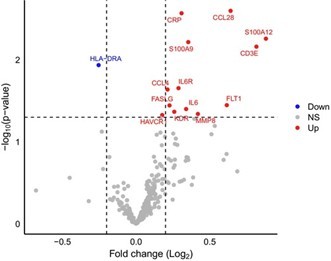
We profiled the serum proteome to identify systemic factors underlying the effects of exercise serum on DNA repair and gene expression in colon cancer cells. Acute exercise significantly increased the relative abundance of 13 inflammatory, vascular, and metabolic proteins (p < 0.05),including IL-6, IL6R, CRP, FLT1, KDR, and S100 family members, indicating acute-phase activation.
In contrast, serum HLA-DRA was significantly reduced, consistent with transient downregulation of antigen presentation. Absolute protein quantification data are available via Open Science Framework.
Study Findings
We profiled the serum proteome to identify systemic factors underlying the effects of exercise serum on DNA repair and gene expression in colon cancer cells. Acute exercise significantly increased the relative abundance of 13 inflammatory, vascular, and metabolic proteins (p < 0.05),including IL-6, IL6R, CRP, FLT1, KDR, and S100 family members, indicating acute-phase activation.
In contrast, serum HLA-DRA was significantly reduced, consistent with transient downregulation of antigen presentation. Absolute protein quantification data are available via Open Science Framework.
Using the proteomic data generated by Altheome:
Distinct proteomic signatures were identified in pre- versus post-exercise serum.
Exercise-induced proteins were linked to pathways regulating DNA repair, immune function, and metabolism.
Functional validation in colon cancer cells revealed that post-exercise serum enhanced DNA damage repair following irradiation, demonstrating a mechanistic connection between systemic factors and cellular responses.
These findings highlight the power of high sensitivity, multiplex proteomic profiling to uncover subtle, biologically meaningful changes that are difficult to detect using conventional methods.
Using the proteomic data generated by Altheome:
Distinct proteomic signatures were identified in pre- versus post-exercise serum.
Exercise-induced proteins were linked to pathways regulating DNA repair, immune function, and metabolism.
Functional validation in colon cancer cells revealed that post-exercise serum enhanced DNA damage repair following irradiation, demonstrating a mechanistic connection between systemic factors and cellular responses.
These findings highlight the power of high sensitivity, multiplex proteomic profiling to uncover subtle, biologically meaningful changes that are difficult to detect using conventional methods.
Applications Beyond This Study
While this study focused on exercise biology and colon cancer, the NULISA platform executed by Altheome has broad applicability across research and translational medicine, including:
Biomarker discovery in oncology, neurology, and immunology
Monitoring therapeutic responses or lifestyle interventions
Translational research requiring deep proteome profiling from limited sample volumes
Applications Beyond This Study
While this study focused on exercise biology and colon cancer, the NULISA platform executed by Altheome has broad applicability across research and translational medicine, including:
Biomarker discovery in oncology, neurology, and immunology
Monitoring therapeutic responses or lifestyle interventions
Translational research requiring deep proteome profiling from limited sample volumes
Altheome’s expertise ensures reliable, publication-ready data that can accelerate discovery, validation, and translation into meaningful biological insights.
Conclusion
By delivering high-sensitivity, multiplexed proteomic profiling, Altheome enabled the discovery of exercise-induced systemic changes and their functional impact on colon cancer cells.
This study demonstrates Altheome’s ability to provide critical, publication-ready proteomic data for complex biological studies, supporting translational research that bridges human physiology with cellular outcomes.
Altheome’s NULISA services are ideally suited for researchers and institutions seeking deep, quantitative proteomic insights in serum and plasma, accelerating the path from biological question to actionable data.
Conclusion
By delivering high-sensitivity, multiplexed proteomic profiling, Altheome enabled the discovery of exercise-induced systemic changes and their functional impact on colon cancer cells.
This study demonstrates Altheome’s ability to provide critical, publication-ready proteomic data for complex biological studies, supporting translational research that bridges human physiology with cellular outcomes.
Altheome’s NULISA services are ideally suited for researchers and institutions seeking deep, quantitative proteomic insights in serum and plasma, accelerating the path from biological question to actionable data.
Conclusion
By delivering high-sensitivity, multiplexed proteomic profiling, Altheome enabled the discovery of exercise-induced systemic changes and their functional impact on colon cancer cells.
This study demonstrates Altheome’s ability to provide critical, publication-ready proteomic data for complex biological studies, supporting translational research that bridges human physiology with cellular outcomes.
Altheome’s NULISA services are ideally suited for researchers and institutions seeking deep, quantitative proteomic insights in serum and plasma, accelerating the path from biological question to actionable data.